
佐々木 真一 教授

佐々木 真一
ささき・しんいち / Shin-ichi Sasaki
職位
教授
学位
博士(理学)(大阪大学)
専門分野
有機合成化学、分析化学、生物有機化学
研究キーワード
超分子、有機光化学、分子認識、バイオ分析、ナノ構造化学、自己組織化
所属
フロンティアバイオサイエンス学科
略歴
- 大阪大学大学院基礎工学研究科博士後期課程修了
- 慶應義塾大学理工学部応用化学科助手、立命館大学理工学部化学生物工学科助手を経て本学へ
研究課題・実績
光合成色素の合成的研究
光合成は太陽の光を利用して水と二酸化炭素から糖を合成する地球上で最大規模のクリーンな化学反応である。その代表的な天然色素であるクロロフィル-a を原料として有機合成的変換を施すことにより、様々な機能を有する誘導体の開発を行っている。色素骨格にもとから備わっている周辺置換基、不斉面、長波長領域の吸収などを有効に活用することにより、人工ポルフィリンにはない特徴を備えた機能性色素類を合成し物性評価を行ってきた。
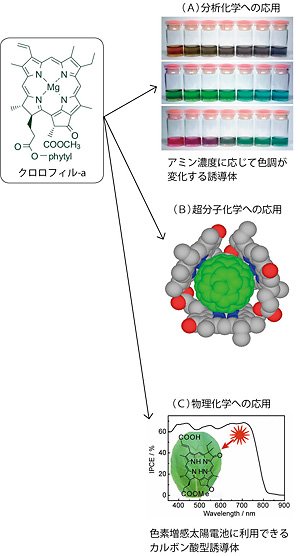
(1)センシング機能を有するクロロフィル誘導体の創製
クロロフィル-aを出発原料としてトリフルオロアセチル基を有するクロリン誘導体を合成し、アルコールやアミンの濃度に応じて色調が変化する指示薬の開発を行った。また、この色素をオプトード膜に固定化した化学センサーにより、水溶液試料中のエタノール濃度を定量することに成功した。
(2)クロロフィルオリゴマーの創製と機能発現
フラーレンを特異的に捕捉できる環状クロロフィルオリゴマーの合成や自己会合挙動を利用した色素集積体の構築を行い、得られた超分子構造について分光学的な検討を行っている。
(3)天然クロロフィル類を素材とする太陽電池用色素の創製
色素増感太陽電池への応用を目的として、カルボン酸部位を有するクロロフィル誘導体を設計・合成し、色素構造と光電変換効率の関係を調べている。また、官能基変換を駆使して近赤外領域に吸収をもつ新規色素を開発し、フラーレン類と組み合わせることにより有機薄膜太陽電池としての特性も検討している。
(4)その他
光合成細菌に含まれるバクテリオクロロフィル類についてもクロロフィル-aからの変換ルートを確立した。天然色素の生分解性に着目した環境調和型分析試薬の開発や、エネルギー問題を見据えた光合成色素ベースの太陽電池の実用化を目指している。
|
研究の応用領域 |
太陽エネルギー利用の新技術開発、環境関連物質の分析試薬開発 |
|---|---|
|
産官学連携で求めるパートナー |
環境エネルギー関連企業、大学、国・地方自治体の研究機関 |
Chlorophyll(Chl)-a is the most abundant dye molecule in nature. Recent synthetic studies using Chl-a as a starting material include application towards sensing components in the field of analytical chemistry, sensitizers for solar cells, and construction of supramolecular structures for mimicking natural light-harvesting antennas.
1
Development of artificial chromoreceptors for the selective recognition of biologically important species has attracted much attention because of their possible application to chemical sensors such as optodes. As a first example of chemosensor using a chlorophyll derivative as a main dye unit, trifluoroacetyl-chlorins were developed for alcohol/ amine detection. The new chemosensors achieved guest sensing at a longer-wavelength region with less interference from environments and impurities.
2
In contrast to traditional silicon solar cells, most dye molecules applied in dye-sensitized solar cell lack lightharvesting ability in the near-infrared region. Because natural chlorophylls efficiently use a wide range of light energy, a series of chlorin derivatives applicable to electrodes have been designed and synthesized, and the relations between structural characteristics and the performance for solar cells have been studied.
3
In the initial stage of photosynthesis, dye molecules represented by chlorophylls are precisely arranged to form light-harvesting antennas, which enable absorption of sunlight, migration of harvested energy, and finally energy transfer to a reaction center. As artificial mimics of such antenna systems, covalently-linked cyclic chlorophyll oligomers as well as synthetic zinc chlorins possessing self-assembling abilities have been synthesized and their structural properties have been investigated.
|
1 |
M. Li, Na Li, W. Hu, G. Chen, S. Sasaki, K. Sakai, T. Ikeuchi, T. Miyasaka, H. Tamiaki, and X.-F. Wang: Effects of Cyclic Tetrapyrrole Rings of Aggregate- Forming Chlorophyll Derivatives as Hole-Transporting Materials on Performance of Perovskite Solar Cells. ACS Appl. Energy Mater., 1, 9-16 (2018). |
|---|---|
|
2 |
Y. Sun, X.-F. Wang, G. Chen, C.-H. Zhan, O. Kitao, H. Tamiaki, and S. Sasaki: Near-Infrared Absorption Carboxylated Chlorophyll-a Derivatives for Biocompatible Dye-Sensitized Hydrogen Evolution. Int. J. Hydrogen Energy, 42, 15731-15738 (2017). |
|
3 |
Y. Li, W. Zhao, M. Li, G. Chen, X.-F. Wang, X. Fu, O. Kitao, H. Tamiaki, K. Sakai, T. Ikeuchi, and S. Sasaki: Chlorophyll-Based Organic-Inorganic Heterojunction Solar Cells. Chem. Eur. J., 23, 10886-10892 (2017). |
| 4 | S. Duan, G. Chen, M. Li, G. Chen, X.-F. Wang, H. Tamiaki, and S. Sasaki: Near-Infrared Bacteriochlorophyll Derivatives as Biomaterial Electron Donor for Organic Solar Cells. J. Photochem. Photobiol. A Chem., 347, 49-54 (2017). |
| 5 | Y. Li, F. Zhang, X.-F. Wang, G. Chen, X. Fu, W. Tian, O. Kitao, H. Tamiaki, and S. Sasaki: Pluronic Micelle-Encapsulated Red-Photoluminescent Chlorophyll Derivative for Biocompatible Cancer Cell Imaging. Dyes Pigment., 136, 17-23 (2017). |